

What You Need to Know About Pollyflex Superplasticizers
Are you facing challenges in achieving effective zonal isolation and long-term well integrity in your oil drilling operations? Do you struggle with ensuring adequate compressive strength and pumpability of your cement slurries, especially in harsh downhole conditions? Then Pollyflex Superplasticizer might be exactly what you need to optimize your oil well cementing process. Pollyflex Superplasticizer is a high-performance chemical admixture that significantly reduces water content in oil well cement slurries while enhancing flow and compressive strength. We provide a high-performance, high-value solution tailored for deep wells, high-temperature environments, and critical cementing operations.
What is Superplasticizer?
A high-range water reducer that enhances fluidity and strength by reducing water content in mortar.
Main Benefits
Exceptional workability, enhanced strength, reduced shrinkage, and improved durability.
Best For
Ideal for high-performance structural repairs, self-leveling mortars, and durable infrastructure projects.
Cost Range
High-value solution that offers long-term savings through enhanced durability and performance.
What is a Water Reducer (Superplasticizer)?
A water reducer, also known as a superplasticizer, is a high-performance chemical admixture that modifies the properties of cement-based materials. Think of it as tiny magnets in cement slurry, constantly pushing away from each other to improve flow.
It's a sophisticated dispersing agent that, when added to cement, reduces the water content needed to maintain workability. This reduction improves strength and durability without sacrificing fluidity. Lowering the water-to-cement ratio results in stronger, more durable concrete, which is essential for high-performance applications like skyscrapers, architectural designs, precast elements, and self-compacting concrete.
In oil drilling, where conditions are extreme, the superplasticizer amplifies cementing performance, leading to better well integrity and improved overall performance.
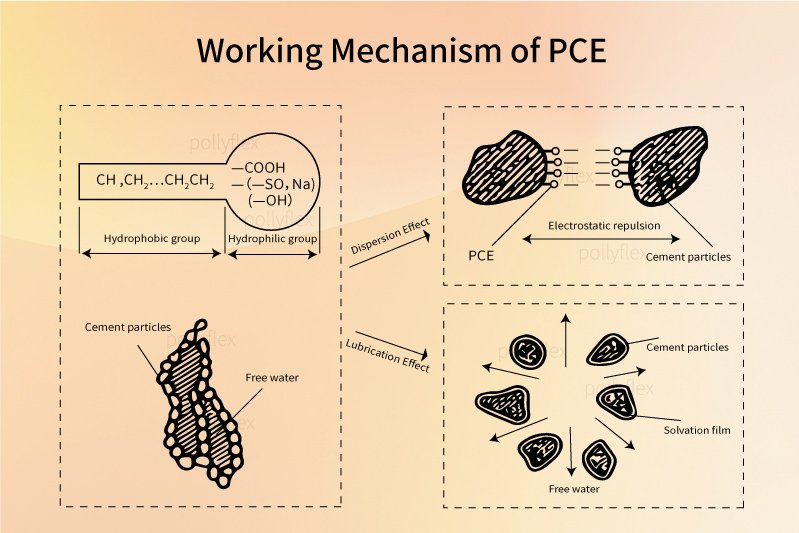
How Do Pollyflex Superplasticizers Work?
Pollyflex Superplasticizers work by a sophisticated mechanism involving the dispersion of cement particles within the slurry. Think of it like this:
The Problem: Cement Clumps:
In a typical cement slurry, cement particles tend to clump together, forming agglomerates. This clumping action traps water within the slurry, reducing its fluidity and increasing the water-to-cement ratio needed for proper placement.
Pollyflex to the Rescue:
Pollyflex Superplasticizers contain molecules that are attracted to the surface of cement particles.
Electrostatic Repulsion:
These molecules attach to the cement particles and create a negative charge on their surface. Since like charges repel, the cement particles are forced to push away from each other, breaking up the clumps.
Steric Hindrance:
Some superplasticizers, particularly polycarboxylate ethers (PCEs), also utilize steric hindrance. The PCE molecules are long and branched, creating a physical barrier that prevents cement particles from getting too close to each other.
Water Release:
By dispersing the cement particles, the water that was previously trapped within the clumps is now released. This free water significantly increases the fluidity and workability of the slurry.
The Result: Stronger Cement:
Because less water is needed to achieve the desired consistency, the water-to-cement ratio can be reduced. This leads to a denser, stronger, and more durable hardened cement matrix, crucial for withstanding the immense pressures and temperatures found in oil wells.
Application Grades in Oil Drilling Cementing
Pollyflex Superplasticizers are adaptable and can be tailored for various oil well cementing applications, each demanding specific performance characteristics:
G-Class Cement (Basic):
In standard G-Class cement slurries used for routine well cementing, Pollyflex enhances pumpability and placement, ensuring complete fill of the annular space. While improving basic properties, the concentration and type are chosen for cost-effectiveness.
High-Temperature/High-Pressure (HTHP) Cement:
For deep wells and geothermal environments, HTHP cement requires specialized admixtures. Pollyflex superplasticizers contribute to maintaining slurry stability at elevated temperatures, preventing premature setting and ensuring adequate compressive strength development.
Lightweight Cement:
In situations where formation integrity is a concern, lightweight cement is used. Pollyflex aids in maintaining slurry stability and preventing segregation of the lightweight additives, while still achieving the desired density reduction.
Foam Cement:
Pollyflex facilitates the creation of stable foam cement slurries, used for minimizing hydrostatic pressure and controlling fluid loss. It ensures uniform bubble distribution and prevents foam collapse during placement.
Remedial Cement:
For squeeze cementing and plug-and-abandonment operations, Pollyflex enhances the penetration of the cement slurry into micro-fractures and improves the bond between the cement plug and the wellbore.
Key Advantages of Pollyflex Superplasticizers in Oil Drilling
Enhanced Compressive Strength:
A lower water-to-cement ratio, achieved through Pollyflex, directly translates to higher compressive strength in the hardened cement. This is crucial for withstanding the stresses imposed by formation pressures and thermal cycling.
Key benefit: Long-term well integrity and reduced risk of casing collapse.
Improved Pumpability and Placement:
Pollyflex significantly increases the fluidity and workability of the cement slurry, making it easier to pump and place even in complex wellbore geometries.
Key benefit: Reduced pumping pressures, minimized risk of premature setting, and complete fill of the annular space.
Increased Durability and Resistance to Chemical Attack:
The denser cement matrix resulting from Pollyflex usage exhibits enhanced resistance to chemical attack from corrosive formation fluids, such as sulfates and chlorides.
Key benefit: Extended service life of the cement sheath and protection of the wellbore casing.
Reduced Permeability:
The tight matrix created by Pollyflex minimizes the permeability of the hardened cement, preventing fluid migration and ensuring effective zonal isolation.
Key benefit: Prevention of cross-flow between different formations and mitigation of environmental risks.
Improved Bond Strength:
Pollyflex promotes a stronger bond between the cement sheath and the wellbore casing, enhancing the overall integrity of the well.
Key benefit: Reduced risk of micro-annulus formation and improved long-term sealing performance.
Superior Slurry Stability:
Pollyflex helps to maintain the stability of the cement slurry, preventing segregation of solids and ensuring consistent properties throughout the cementing operation.
Key benefit: Predictable performance and reduced risk of cementing failures.
Extended Working Time:
The use of Pollyflex can extend the working time of the cement slurry, allowing for more flexibility in placement and reducing the risk of premature setting, particularly in high-temperature environments.
Key benefit: Allows for longer pumping operations, especially critical in deepwater or extended reach wells.
Pollyflex Polycarboxylate Superplasticizer: High-Performance Superplasticizer for Oil Well Cementing
Pollyflex PCE is a specifically formulated superplasticizer designed to meet the demanding requirements of oil well cementing. As an essential tool in modern construction for producing high-performance concrete with improved strength, durability, and workability, especially when challenging architectural or engineering specifications must be met .
| Parameter | Typical Value |
|---|---|
| Effective content (%) | 97% ± 1 |
| Water Reducing Rate | ≥25 |
| pH | 6.0 ± 1.0 |
| Recommended Dosage | 0.2% - 1.0% by weight of cement (BWOC) |
| Key Features | High water reduction, excellent slump retention, improved compressive strength, enhanced durability |
| Service Advantages | Free samples available, global shipping, custom formulation options |
Pollyflex SP provides exceptional water reduction capabilities, leading to significant improvements in cement strength and durability. Its unique formulation ensures excellent slump retention, maintaining slurry workability for extended periods. We offer complimentary samples to allow for thorough testing, provide worldwide shipping to accommodate international projects, and offer custom formulation services to tailor our product to your specific oil well cementing needs.
How to Select the Right Pollyflex Superplasticizer
Choosing the appropriate Pollyflex superplasticizer depends on several factors related to the specific well conditions and desired cement properties:
| Factor | Considerations |
|---|---|
| Well Depth | Deeper wells require higher strength and greater resistance to HTHP conditions. |
| Temperature | Higher temperatures necessitate superplasticizers with excellent thermal stability. |
| Formation Fluids | The presence of corrosive fluids (e.g., sulfates) requires a superplasticizer that enhances chemical resistance. |
| Cement Class | Different cement classes (e.g., G, H) may require different superplasticizer dosages for optimal performance. |
| Slurry Design | The desired slurry density, thickening time, and fluid loss control will influence superplasticizer selection. |
Pollyflex Superplasticizer Selection Guide
Here's a quick guide to help you choose the right Pollyflex Superplasticizer for your specific needs:
| Well Condition | Recommended Pollyflex Grade | Dosage (BWOC) | Key Benefits |
|---|---|---|---|
| Shallow Wells / General Applications | POLLYFLEX-PCE Flake 670 | 0.2% - 0.4% | Well-rounded performance: good pumpability, balanced strength, reliable overall behavior |
| High-Performance / Deep Wells | POLLYFLEX-PCE Flake 680 | 0.4% - 0.7% | High water-reduction capability, excellent for achieving lower water-cement ratios |
| Sulfate-Rich / Slump-Sensitive Formations | POLLYFLEX-PCE Flake 690 | 0.6% - 0.9% | Outstanding slump retention, enhanced sulfate resistance, better long-term workability |
Usage Instructions and Precautions
Add Pollyflex Superplasticizer to the mixing water before adding cement.
Thoroughly mix the slurry to ensure uniform dispersion of the superplasticizer.
Adjust the dosage of Pollyflex based on the specific cement class and well conditions.
Do not mix Pollyflex with incompatible admixtures without prior testing.
Store Pollyflex in a cool, dry place away from direct sunlight.
Key Suggestion: Conduct trial mixes with your specific cement and water source to determine the optimal dosage of Pollyflex for your application.
Ordering and Sample Request Information
| Details | Information |
|---|---|
| Packaging | 200 kg drums, 1000 kg IBC totes |
| MOQ | 1000 kg |
| Lead Time | 7-14 days |
| Payment Terms | T/T, L/C |
| Shipping Options | Sea freight, air freight |
| Sample Policy | Free samples available upon request |
| Custom Formulations | Available to meet specific project requirements |
Quality Control and R&D Advantages
At Pollyflex, we ensure strict quality control at every stage of production to guarantee consistent product performance. Our advanced R&D facilities focus on continuous innovation, developing new superplasticizer formulations tailored to the oil and gas industry's evolving needs.
Equipped with state-of-the-art testing tools like rheometers and compressive strength testers, we aim to enhance temperature stability, improve cement compatibility, and create environmentally friendly options.